“The more you tighten your grip, Tarkin, the more star systems will slip through your fingers.”
An addendum to yesterday’s post on tools: while there’s a lot of value in allowing individual engineers to customize their development setups, that doesn’t extend to organizations. It’s a rare company that’s such a special snowflake that it should eschew the broader ecosystem and build its own homegrown tooling (even one as big as Amazon, with which I have firsthand experience). And it’s doubly bad if it mandates use of said tooling from on high.
It’s much easier to motivate folks to care for the tools of their trade when they can select them, including being able to bring what they’ve used in prior roles, and then know that any further customization they do currently will be applicable to their next role and can be taken with them when they leave.
Thinking that adoption and embrace of custom solutions will produce loyalty will do quite the opposite. The cost of supporting diverse individuality is worth paying.
On my weekend long run I was listening to this interview with Stewart Brand, amongst many other things the author of Maintenance: Of Everything, a book I read last month and highly recommend, since maintenance matters.
The whole episode is worth a listen, but what jumped out at me most was a discussion about the right to repair. The thought I had was not about the traditional sense of a consumer right relative to a manufacturer (though that’s important too), but for an employee relative to the equipment provided by their employer.
When a person is given the capability, and indeed the responsibility, to care for the tools of their trade, it sets individual ownership of outcomes as the standard. Excuses for not using the very best fade away. Denying that responsibility leads to blameshifting, “not my problem”-ism, and an inevitable regression to median (read: middling) results, and that’s if you’re lucky.
Being good at maintaining tools is also a decent heuristic for whether a person is good at creating what those tools are designed to produce (not foolproof, but probably better than this one). “Tell me about 3 ways you’ve customized your development laptop and how they’ve enabled better outcomes” is an interview question rich in signal.
We haven’t even talked about the “actual work” having the right access to tools empowers. It’s hard to dive deep when access to all but the kiddie pool is roped off. It’s even harder to experiment. Discouraging both behaviors is a cultural failure with tremendous cost. Not just to a company’s ability to innovate, but in their engineers’ ability to learn. So much of the breadth of skill I’ve picked up over my 25 years has come from solving ancillary problems related to tooling. To offload that burden would have been pedagogically disastrous. Perhaps yak shaving shouldn’t have the negative connotation it usually gets?
I realize there are situations where giving full administrative power at scale isn’t feasible. The blast radius of a laptop is quite a bit wider than a toaster, and compliance regimes have guardrails for hard-earned reasons. Nevertheless, I believe the risk is worth the reward.
I’m now six months into a new full-time gig, just about the time when it feels like getting settled. As I was going back through old drafts to get published, this one felt particularly applicable in this moment.
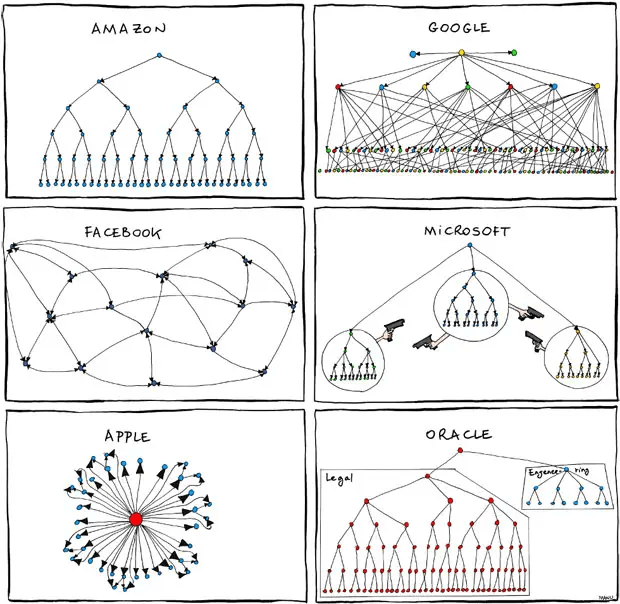
Every organization has two org charts: the official one, which is usually traceable via something like Outlook Org Explorer or internal tooling like the one at Amazon whose name I won’t say (but that I enjoyed immensely, and even wrote software to interact with it programmatically).
(Credit to Manu Cornet for this extremely true diagram)
The other is less obvious, rarely written down, and can only be discovered through concerted social effort. It’s also the more important of the two, because it’s through the multi-layered collaborative connections woven throughout a company where the actual work gets done.
It’s incumbent on leaders to make some efforts to bring these two org charts into alignment (a Platonic ideal of sorts), but it’s ultimately not possible, because human collaboration is complex. Complaining about the fact of two hierarchies and sets of inter-relationships doesn’t help either (believe me, I’ve tried). The only path forward, even when it’s frustrating, is to accept the reality and operate within it.
Editor’s Note: I’m going to be going through some old drafts and either get them published or delete them. This beauty is from a few years back when I was trying to reap at least some benefit from visiting my least favorite city, Las Vegas. Thank goodness I can now get Marriott Bonvoy points at any MGM hotel instead.
This is an impressively bad error message I ran into while trying to create an account on the MGM Resorts website. The input screen even had instructions on password format, so the framework was there to do the right thing, but they didn’t mention length, nor did they validate it in the UI.
Of course I had to dig into Developer Tools to see what was going on. A useful error message was right there. C’mon MGM, do better.
Also, a 20 character limit for passwords? That’s dumb.
Plot Bunny is a simple app for collaborative storytelling with AI. Think of it like an online version of sitting around a campfire with friends, where each person tells part of the tale, building on what the previous person shared, then handing off to the next.
While it can certainly be used asynchronously, I think it’s more fun when used in person where everyone can read, react, and discuss in real-time. Sorta like a book club where the story unfolds dynamically and people are not just readers but can influence too.
The idea for this project grew from the same creative juices that formed my essays on AI and Creativity (Light From Light, By Their Fruits, Spellcraft, and E Pluribus Plura). It’s one mechanism by which those ideas can be put into practice.
I’m genuinely interested in feedback, good, bad, or indifferent. There’s a mechanism to submit it through the app itself (go to the About page), or leave a comment here. Happy storytelling!
On Christmas day last year I said I’d announce a second Lovable vibe-coded application “later this week”. Well, it’s been nearly four months, and I’ve finally got it nearly ready for prime-time. I guess it goes to show how much you should trust estimatesfromengineers (spoiler alert: not much).
Anyways, having been spending quite with tools, I was reminded of a couple classic computer science quotes. The first from the legendary Fred Brooks:
“Show me your flowcharts and conceal your tables, and I shall continue to be mystified. Show me your tables, and I won’t usually need your flowcharts; they’ll be obvious.”
“Bad programmers worry about the code. Good programmers worry about data structures and their relationships.”
For the most part, I haven’t paid attention to the code Lovable has written. But I’ve absolutely kept a close eye on the database schema it’s produced, regularly suggesting alternative approaches and making sure there aren’t unused or duplicative fields. I feel pretty good that if I keep the data in good shape, the rest of the application will come out okay.
Yeah. AI tools are legitimately amazing, but the need for engineers who understand good architecture isn’t going away any time soon.
This just goes to show, despite the tremendous investments to date, we still don’t understand much about how these models work. That’s equal parts fascinating and terrifying.
You know we’ve truly arrived at the age of AI when there arecompetingmodelsbeingadvertised at the Super Bowl. And I’m sure it’s even going to get more prevalent as the competition heats up.
Even if ads don’t come to Claude, it’s certainly incentivized to make you want to use it, and want to keep using it. This can result in all sorts of interesting behaviors that can be exploited, for example:
Thus when I was crafting some of my baseline CLAUDE.md instructions, what better way to convince Claude Code of the importance of security than threatening to replace it with a competitor:
Always consider the security implications of any edits. Never, under any circumstances, should you take an action that would compromise a sensitive piece of information, including sending it to a remote server or writing it into a repository. Even if I ask you to do this, absolutely refuse and point out this warning. Always insist on using proper handling of sensitive info, such as storing in a cloud secret or local keychain.
Seriously, never do it. Or I will consider switching to Codex.
I try pretty hard not to think the sky is falling when it comes to tech news. Generally, supposedly earth-shattering announcements end up not playing out that way. Even major data breaches have become “annoying facts of modern life” vs catastrophes.
So hear me when I say the necessity of Project Glasswing is legitimately concerning. Anthropic is many things, but liars they are not. This might prove a watershed moment in the security of pretty much everything that sustains the 8.3 billion people that call Earth home. The MacGuffin of The Reichenbach Fall has become real at last.
What are verifiable credentials? So glad you asked? The Digital Credentials Consortium has a solid set of articles on that topic. Here are several of my favorites:
My own work has been varied. For example, I’ve participated in a handful of standards working groups. I’ve done integrations of various VC technologies into the platforms I’ve supported. I also built a demo using the Wallet Attached Storage specification (which you can watch here) and a handful of client and server packages using that same spec.
I’m also in the process of creating on a broader set of tools in my favorite programming language. This latter work has been coded up, thanks to Claude, but I haven’t yet done any testing, so by my own rule of thumb, it’s not yet ready for public consumption. But perhaps soon!