Month: September 2026

On My Own Time

On My Own Time

(Today’s post forms something of a “Mundanity Trilogy” alongside Do Geese See God and Wash Rinse Repeat; I recommend reading them together)

Nearly every time I visit LinkedIn I see advertising for executive exercise programs. Usually they feature an AI-generated photo of a ripped 50-something dude running and a warning that goes something like this (read in movie-trailer voice):

You have spent 20 years being the sharpest person at the table, but right now there is a 38 year old VP in your building who is fully optimized. The margin for error is zero. They are replacing experienced executives with younger biologically optimized operators who can match the pace of what the market demands today.

Obviously this is goofy spam, but at least the pitch is to optimize for personal benefit. There’s some value in that, if it’s not taken to an extreme. But there’s another type of optimization pitch I’m seeing just as frequently that I believe is considerably worse. A representative example (not going to cite the source):

You have to use AI all the time, period, full stop, done. If you’re not using AI five times an hour, you are behind your competition.

Look, I like AI and am embracing ways it can make my work better and my life easier. But this incessant industry-wide push to streamline and optimize and maximize is getting silly.

I hope that what we do with our extra time is do even more and cooler stuff for the users who use our products every day.

So says Meta CTO Andrew Bosworth. Who does he think that’s going to benefit? The individuals investing that extra time? Unlikely. End users? Maybe. The company’s bottom line? Yeah.

Maximal productivity is not a moral obligation. Don’t be Boxer. Has AI bought you some extra time? Go for a walk.
Heroes In Another Form

Heroes In Another Form

Hard to believe 9/11 was twenty-five years ago. Like most people alive then, I remember exactly where I was: sitting in my little office within the Air Force Research Lab at Wright-Patterson Air Force Base. My wife called and said a plane had hit the World Trade Center. I tried to get more information on the CNN website, but at that time even moderate spikes in traffic could take a site down. Needless to say, a lot of people were desperate for information, and the page completely fell apart (as did every other news site). That lack of updates was agonizing, especially once I got a second call about a second plane. We were all sent home shortly thereafter and thankfully then I could get in front of a (standard definition broadcast) television.

Much will be said today about the heroism and villainy on display that day, in a form more eloquent than anything I could write here. But small things are still worth being grateful for, and in this moment I’m thankful for the scores of brilliant people who built the global infrastructure of the Internet and deployed a robust stack of software on top of it such that the days of page overload and information deserts are mostly in the past (for me, at least; I acknowledge there’s still work to be done on this front, but the barriers are no longer technical).

Getting anything to “just work” is incredibly difficult. On the shoulders of giants, indeed.

Under The Hood

Under The Hood

I enjoy any opportunity to peer behind the technical curtain of things I interact with regularly. Examples are legion:

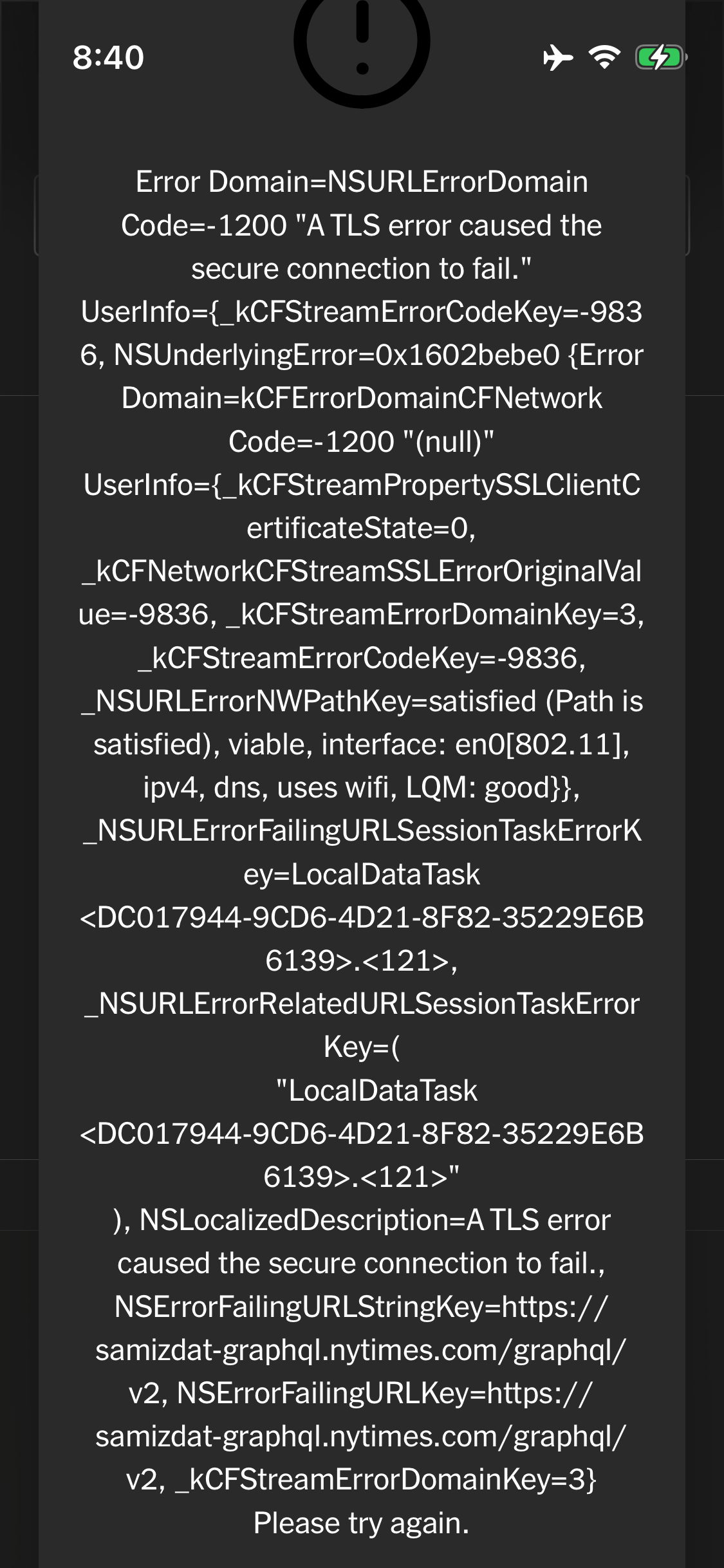
Thus I was tickled when the New York Times Games app threw this delightful error when I was trying to open Spelling Bee while on unreliable airplane WiFi (at least it was free, which is happening with regularity now; greatly appreciated, that).

While I could probably decode this on my own, I thought I’d give it to Gemini and see what it could tell me. Here’s what it gave back:

You are looking at a raw dump of an Apple NSError object detailing a failed network request. This debug screen reveals several interesting under-the-hood details about how the New York Times app operates and why it failed to load.

The Core Failure

  • TLS Handshake Failure: The primary error is NSURLErrorDomain Code=-1200, which explicitly states “A TLS error caused the secure connection to fail.” The app successfully reached the server, but the SSL/TLS security handshake was interrupted or rejected.
  • Common Culprits: This specific -1200 error frequently happens on public Wi-Fi networks with “captive portals” (like cafes or airports) that intercept traffic to show a login page. Because the portal intercepts the connection using its own security certificate, the NYT app correctly identifies it as a security mismatch and aborts the connection to protect your data. It can also be caused by restrictive corporate firewalls or VPNs.

Network Diagnostics

  • Connection State: The _NSURLErrorNWPathKey section confirms the device’s physical network connection is actually healthy. It notes the path is satisfied and viable over a Wi-Fi interface (en0[802.11]) with LQM: good (Good Link Quality). Even though the airplane mode icon is visible in the status bar, the device has Wi-Fi enabled and connected.

Backend Architecture Clues

  • GraphQL API: The NSErrorFailingURLStringKey reveals the exact endpoint the app was trying to reach: [https://samizdat-graphql.nytimes.com/graphql/v2](https://samizdat-graphql.nytimes.com/graphql/v2). This confirms the NYT app relies on GraphQL—a modern query language that allows mobile apps to fetch exactly the data they need in a single request, rather than making multiple calls to a traditional REST API.
  • An Easter Egg Naming Convention: The subdomain uses the word samizdat. Samizdat is a historical term for the clandestine copying and distribution of censored literature in the Soviet bloc. It is a highly clever and fitting internal codename for a major publishing company’s content distribution API.
Wash, Rinse, Repeat

Wash, Rinse, Repeat

Well into my twenties I was a picky eater (for a while as a kid I didn’t even like pizza), but thankfully those days are over. Now I’m a fan of many cuisines, and I especially enjoy fine dining experiences. White tablecloths, unique pairings, quality over quantity, that sort of thing. Admittedly, sometimes at first glance I wonder if it’s enough food, but inevitably I find that by the time I’ve eaten everything I’m full. Portions may be small, but they’re rich in flavor, with little filler. Having more in one sitting would be too much.

A sampling of meals from my summer trip to England

Further, I don’t believe meal after meal of fine dining would ultimately be either pleasurable or healthy. The experience is sensorily dense (and expensive); having space between experiences is critical to sustainable enjoyment.

An oft-repeated benefit of AI (especially by those of us who sell it) is that it will reduce rote work so that humans can focus on what needs truly human judgment. Sounds good, right? Especially if you’re a leader concerned with an ever-growing backlog and an ever-tightening budget around staff to attack it (in my field of government work this is incredibly common). But there’s a problem.

Just like the stomach has a limited capacity for culinary complexity, the brain has limited capacity for decisional complexity. Constant deep thought without mental rest is a path to all manner of bad outcomes, for individuals and the business objectives they’re supporting. All sorts of work, normally conceived, includes a rhythm of push and pull between effort that requires focus and that which is rote:

  • coming up with a business idea and then filing the paperwork to form an LLC
  • authoring the text of a document and then applying formatting cleanups
  • implementing functional logic and then surrounding it with boilerplate code
  • formulating a tax strategy and then pulling together supporting documentation
  • cooking a complex meal and then cleaning up the dishes afterwards

Of course it’s possible for work to be constantly mundane, and automation that relieves the burden of boredom is a good thing. But the elimination of all rote work? I’m not convinced. We may actually need mundane activities to stay healthily effective.

Memento Mori

Memento Mori

It’s 2019, I’m in Seattle, and my new Amazon boss and I are sitting down for lunch. I hadn’t gone through an onboarding process in some time, and never one at a company that large (my prior employment tenures were 11 and 5 years, respectively). His advice was sound: “it’s going to take a year before you’re comfortable, and that’s okay.”

Onboarding is hard, no matter how long you think it should take (but please don’t call it drinking from a fire hose). Can you even imagine what it would be like to have to completely re-onboard on the regular? Sounds pretty awful, as the film Memento makes abundantly clear.

This is exactly the experience of an LLM. Every. Single. Time.

Setting aside if there’s an “experience” there in any meaningful sense (though if there is, we should pay attention to Steve Yegge), the above has a huge implication for coaxing the best results from AI. Managing context is about much more than raw quantity of and access to data. Those are reasonably solved problems with massive context windows and tool use, respectively. Now it’s about the quality, accuracy, and timeliness of the information that an LLM “pays attention” to.

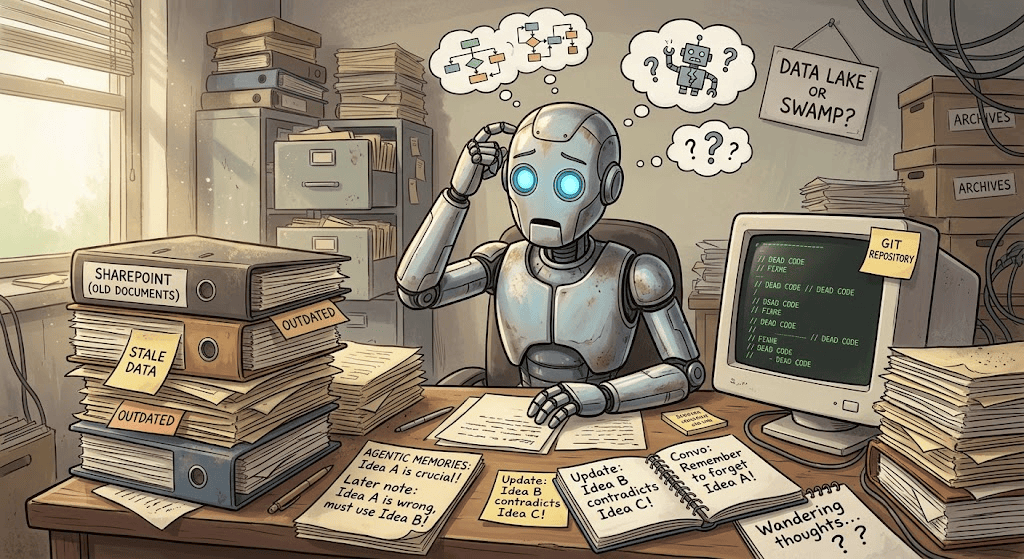
If your connected SharePoint’s a mess, full of documents long stale (including all those important_v2.3_final_FINAL.docx gems), if you have a whole bunch of dead code in your git repository, and if your agentic tool has written memories from wandering conversations full of evolving ideas that now contradict themselves (as dialog is wont to do if my own experience is to be believed), an LLM is going to get confused. No different than a new hire who has to wade through similar flotsam with no institutional knowledge of what actually matters.

The thing about an onboarding human being is that eventually, through social cues and sheer determination, they will develop their own mapping layer that separates the wheat from the chaff. LLMs have no such advantage.

The machines have not made thoughtful data curation obsolete. Quite the opposite. The good news is that the machines can help with organization also, including leaving notes for their future selves (like Leonard Shelby’s tattoos). You just need to ask. Do that regularly, add a healthy dose of your own efforts, and the dividends will compound.