Next To Godliness

Next To Godliness

For the first five years of my career, I worked for a defense contractor located on-site at an Air Force research facility. My job was to write software, but the lab had quite a bit of hardware as well. Over time, things could get pretty messy as we were regularly reconfiguring the setup, leaving random cables and parts strewn all over the place.

We must not have been unique in this, because about half-way through my tenure there the powers-that-be started a “tidying up” initiative that everyone was required to participate in, up and down the ranks, including uniformed military, civilian, and contractors. Being already something of a neat freak, I bought some split loom tubing (from Parts Express, my absolute favorite source for A/V parts) and used it to bundle all the cords at my desk. Apparently I’d done such a good job that word got around about my setup, and one afternoon the person at the top who’d launched the cleanup initiative stopped by and thanked me for my efforts, and said my desk was the example that others in the building should emulate.

Ever since I learned proper cable coiling technique I’ve enjoyed keeping areas with many of them as neat as possible, ideally with none of them visible. Today I was happy to do so in my wife’s classroom, including installing a light strip since the cubby where her desk lives is in a poorly-lit corner.

I didn’t need much nudging to do this; now the drive to tidy cables is a bit of a compulsion. If I ever see random ones laying about (such as on a conference room table), I’ll coil them out of habit. And if I ever see someone doing it wrong you can be sure I’ll have something to say about it. Yes, there is a right way, and it’s easy to learn with a bit of practice, so no excuses.

Work In Progress

Work In Progress

Two things can be true at the same time.

On one hand, I’m thrilled to be working in the most diverse organization I’ve ever been a part of. Our founder and chair of the board is a woman. My boss (the CEO) is a woman. I’m the only man in the C-suite. Our broader leadership team is 75% women. And the company at a whole sits at roughly 50/50.

On the other hand, I recognize we can still do better. The language and metrics I just used, for example, which reflect a binary that isn’t representative of the richness of human form and experience, let alone all the other dimensions of diversity that aren’t as varied on the team. The levers we can pull as a small organization are constrained, but at least we’re starting from a good place; as opportunity arises I intend to make further improvements.

Celebrate the wins yet strive for more, because when it comes to being Earth’s best employer, it’s always day one.

Have It Your Way

Have It Your Way

My first real job was at Burger King, which I got at my dad’s behest the summer of 1994. I was only 15 years old, and what I could do was pretty limited (no food prep, nothing to do with the deep fryer, couldn’t even do dishes because of knives). But what I could do was operate the register and take orders. On balance it was a positive experience, not least because it taught me how to talk to strangers.

I’ll never forget one particular aspect of my training. There was a question we were expressly forbidden to ask when interacting with customers, and if we ever did, even accidentally, our manager would yell at us from across the kitchen. The question?

Is that it?

Why was it verboten? Because it shuts down conversation. In social situations humans are wired to want to answer questions in the affirmative, and a “yes” response to that question means no more items to add to the order, and my corporate overlords definitely didn’t want us to encourage customers to stop adding fries, drinks, desserts, and more. What question were we instead instructed to ask?

Is there anything else?

The difference is significant, as an affirmative answer here encourages the customer to go ahead and keep ordering, subtly suggesting that perhaps there’s more they would enjoy. I realize now, though, that there’s an even better way to nudge a person to continue speaking what’s on their mind.

What else?

I first picked up this simple but effective question from one of my managers at AWS, as he would use it throughout our 1-on-1 meetings to get me to be honest about what I was thinking and feeling about my job. This question works because unlike the prior one, it assumes that a person already has more to say, nudging them to say it. I know it worked on me (I had no shortage of opinions to share, no doubt).

It reminds me of another short but powerful prompt that can take a conversation to the next level:

Tell me more.

When trying to listen actively, it can be a challenge to think of relevant follow-up questions in real-time, especially with a person who’s taciturn, or if you don’t have a prepared agenda. “What else” and “tell me more” are great because they can be used at any lull in the conversation; keep them at the ready, and they won’t let you down.

“For millions of years, mankind lived just like the animals. Then something happened which unleashed the power of our imagination. We learned to talk and we learned to listen. Speech has allowed the communication of ideas, enabling human beings to work together to build the impossible. Mankind’s greatest achievements have come about by talking, and its greatest failures by not talking. It doesn’t have to be like this. Our greatest hopes could become reality in the future. With the technology at our disposal, the possibilities are unbounded. All we need to do is make sure we keep talking.”

Stephen Hawking
Here And There And Everywhere

Here And There And Everywhere

Just in case the post on crossword solve times didn’t make it obvious enough, I like to track things. I suspect it’s a corollary of liking gamification. Here’s a rundown of info I’m keeping and the tools I’m using:

This post is itself is also a tracker. A tracker of trackers; a meta-tracker, if you will.

Better Together

Better Together

Today the United States celebrates its independence. Amongst the barbecues and fireworks, it’s worth taking a few minutes to reflect on the significance of this day in history. For me, I’m most thankful for the contributions of this country’s founders to the ideals of good government.

We’ve had no shortage of trouble in living up to those ideals, and I’m convinced that some considerable reforms are still needed given how the nation has evolved (see Breaking the Two-Party Doom Loop for my favorite take on that subject), but on the whole, the system of government we enjoy with its equal representation, checks and balances, and problem solving using negotiation and compromise vs violence, has promoted human flourishing both here and around the world (well, sometimes at least).

It’s been a privilege of mine to work in the public sector for most of my career, and I don’t expect that to change anytime soon, as I’ve doubled-down on situating myself at the intersection of tech and politics. I figure it’s how I can best honor those who got us this far; to continue the quest for developing better governmental systems and policy.

I’m not alone in that effort, as I’ve been able to meet a lot of great people along the way, dedicated public servants who really care about improving lives. Perhaps you too should consider joining our ranks? Governments are positioned to solve numerous problems both big and small, and they need the kind of smart problem-solvers that tech folks typically are. It may not be glamorous, but it’s desperately needed.

Fix-It-Up Chappie

Fix-It-Up Chappie

Over the weekend my daughter’s Chromebook stopped turning on. We’ve gotten our money’s worth, having bought it right before the pandemic (fortunate timing, that), but I suspected the issue was only with the battery, having experienced a similar failure mode with other Chromebooks. Fifty bucks, overnight shipping, and fifteen minutes at the kitchen table, and it’s back up and running. Yay!

I usually enjoy trying to repair things. I don’t always succeed (especially if it’s car-related, I leave that to the professionals after a disastrous attempt to patch a radiator leak in an ’87 Honda Civic back in the summer of 2005), but stuff like electronics or minor carpentry things I can usually figure out (not to mention identifying and working around website bugs). There’s something imminently satisfying about learning something new and immediately applying it to bring a tiny bit of order to the entropy.

You may think you don’t know how. And you may be right. But finish the sentence: you don’t know how yet. More than ever before there’s a wealth of knowledge at your fingertips. Engage your curiosity and give it a try. The risk is (usually) minimal and the rewards many.

Half The Battle

Half The Battle

Some things are just good to know, for example:

  • git
  • SQL
  • networking protocols (UDP, TCP, HTTP, SSH, DNS)
  • the relative speeds of various storage media (L1, L2 caches, RAM, and disk)
  • the airspeed velocity of an unladen European swallow

Add to that list OAuth2, the lingua franca of authentication. Get yourself acquainted with this helpful two-part series:

In Remembrance

In Remembrance

When I was laid off back in early 2019, my emotions ran the gamut from sadness to fear to anger. That isn’t terribly surprising. But one feeling caught me off guard, and it took me a couple weeks of unemployment to name it: loneliness.

It’s not as if I was truly alone; I still had my family, who are awesome, and friends I saw regularly. But so much time is spent with coworkers, time that requires no planning or effort in the way that maintaining other friendships requires, that inevitably colleagues become a significant slice of a person’s social circle, and when that’s suddenly taken away it can be a shock.

While not as acute, there’s a similar feeling when a job is left voluntarily. As soon as word got out about my departure from my previous job, even though I was sticking around for a couple weeks to ease transitions, my interactions with coworkers changed, an unspoken realization that further investment in these relationships had limited value. “Let’s stay in touch” is a common refrain, but to do so takes effort that usually doesn’t get made. No matter how strong the connections may seem (and given the nature of things like mutual goal pursuit and shared trauma, they can feel quite strong), once the bond of shared employment and daily interaction is broken, that’s usually the end of it.

Nevertheless, I truly value the “work friendships” I’ve had during my career, even if they only last for a season. I was enjoying an afternoon coffee a while back reflecting on this topic, and a wave of nostalgia hit me hard enough that I decided to do something about it, sending out a bunch of LinkedIn “hey how’s it going?” notes and planning a happy hour get-together for former employees of the startup I worked at from 2014 to 2019. The latter happened this past week and it was delightful catching up with folks, most of whom I hadn’t seen in years.

Besides the upheaval that comes with job changes (voluntary or otherwise), the nature of work friendships are changing thanks to remote employment. I’m a big fan of ditching the commute and having a flexible schedule, but it does comes at the cost of the communal benefits of an in-person office. For many folks social circles are shrinking (see Bowling Alone for a deep dive on this phenomenon in America); not going to an office isn’t helping.

The above has me thinking about alternatives ways to help people fill this gap, tech people in particular, and tech leaders especially, since their potential for loneliness is compounded by being in positions where they can’t be completely transparent with the majority of their colleagues. More to come on this soon.

Truth At The Intersection

Truth At The Intersection

Earlier this year I pledged to read 32 out of my 44 books by authors who are either non-white or non-male, 73% of my total. Juneteenth seems like an excellent day to see how I’m doing, given both its significance to my objective, as well as it being near the middle of the year.

As of today I’ve completed 24 books, ahead of my required pace of 22 by this date. Of those, 4 were written by white women, 2 by non-white women, and 10 by non-white men. That’s 16 in total, or 67%, which means I need to pick up my pace a bit to hit my goal. Of my current 3 books in flight, 2 are by women and 1 was written by a consortium of indigenous folks, so that’ll help things out. And I’ve plenty more qualifying books in my queue.

If you’re curious, you can see what I’m reading any time on my Goodreads page.

Show Me The Data

Show Me The Data

For Christmas back in 2020 my daughter got me a daily crossword puzzle calendar. That started a streak of completing a puzzle every day for two years. I tracked data on how fast I was able to complete each one, curious if I would get measurably better over time.

Today I finally sat down, put all the data into Excel, and crunched some numbers. Here’s a couple interesting results (interesting to me, at least):

Normally I aimed to complete a puzzle in about 15 minutes. For the most part my results clustered around that value, though my overall average across 623 puzzles was 15.9 minutes thanks to the occasional outliers in the 30-ish minute range. Fastest solve time was 6 minutes, which I accomplished 7 times.

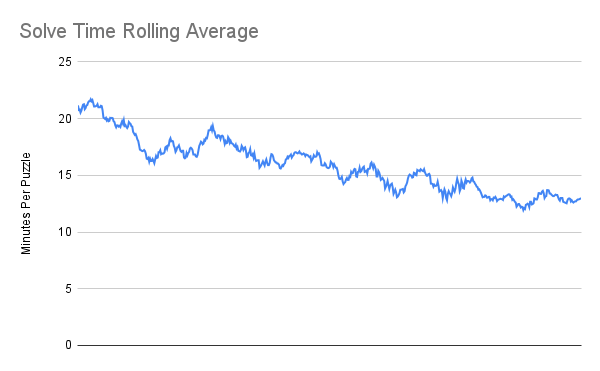
This graph of rolling average (with a 30 day window) pretty clearly shows I got better over time as I suspected, going from a 20-ish minute average at start all the way down to 13-ish minute average towards the end. I’m happy with those results!

In total, I spent 165 hours working crosswords in 2021 and 2022, and while it’s not exactly the world’s most productive activity, there’s enough mental benefit that I don’t regret it.