Routinely Solicited Inquiries
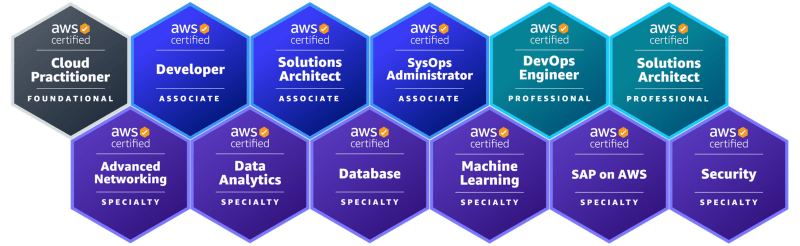
When I joined Amazon Web Services in the fall of 2019, I wanted to validate the experience I had through AWS Certification. It become something of an obsession, and I ended up passing all 12 exams within a year. I got frequent questions about this experience, enough that I developed a talk that I gave at a couple internal conferences, and once at re:Invent. This post is my best attempt to capture what I said there, plus some additional information that might be of interest to anyone seeking to up their cloud game.
Why?
The first question I typically get is a variant of “Why did you pursue AWS certifications?” And that’s usually followed-up with “And why so many of them? Did you actually absorb any of that information?”
There are plenty of places to get boilerplate answers to these questions, such as Benefits of Being AWS Certified and Four reasons you should pursue AWS certifications. For me it boiled down to wanting the broadest possible exposure to AWS services. Certifications were not the end of my cloud learning journey, they were the beginning of it. I’m a breadth person; my goal was not to get hands-on experience with everything, but rather to get high-level understanding so that I could apply the technology to customer problems. I also wanted to be able to have public verification of the skills I already had.
Is there also a depth benefit to certs? Yes, but the study approach is different than the one I present later in this article. You’ll want to focus more on hands-on workshops and less on purely information intake. Neither approach is better or worse, they simply have different end objectives.
Who?
Another common question is “Who should get AWS certified?” I’m admittedly biased, but given they’re relatively inexpensive and can only benefit one’s career, I tend to say yes to just about everyone who works in or around the cloud:
- Technology professionals specifically tasked to build in AWS? Obviously.
- Software engineers who might be called upon to do cloud things, and should know what’s out there so they don’t inadvertently re-create the wheel? Definitely.
- Tech adjacent folks like product / project / program managers and salespeople who want to be able to hold their own in cloud-related conversations? Can’t hurt.
- Executives whose companies heavily utilize the cloud? Why not?
How?
Hopefully by now you’re convinced, so the next question is obvious: “How can I decide which certification(s) to pursue?” There’s decent guidance in the AWS Certification Paths brochure (which I like to take some credit for, as I both recommended its development to the Training & Certification team back at re:Invent in 2021, and consulted with them on its content), but I’ll add my two cents here as well.
Cloud Practitioner is the foundational exam, appropriate for anyone who wants to beef up their AWS knowledge no matter their role. Even for folks that already have cloud experience, I recommend they take this first just to learn the logistics of the exams. Lean into your bias for action here and just do it; at the time of this writing it’s only $100 and there’s no consequence for failing (which is true for all the exams).
After that one, I think Solutions Architect Associate is the best next step, as it’s a great introduction to solving problems on AWS. For technical folks especially it’s my first recommendation, and for non-techies who still need to hold their own in a cloud conversation it’s a perfect stretch goal.
From there, it starts to depend on role, but for those who have to wear a lot of hats the aim should be either Solutions Architect Professional or DevOps Engineer Professional (ideally both), and to prep for them there’s value in picking up SysOps Administrator Associate and Developer Associate as study guides. The material builds on itself, but be aware there’s a considerable jump in difficulty between the associate and professional exams.
Because passing an exam earns you a coupon for 50% off your next one, completing all the foundational, associate, and professional exams can be done for as little as $625. That’s not a large investment to pick up highly marketable certifications.
The specialty exams are different in several ways. For one, they contain much more completely new material compared to the way the professional exams build on associate exams (with one exception: if you have all the general certs, you’re 80% of the way to getting the Security Speciality). So if you’re a novice, expect to invest quite a bit more study time. I can’t really recommend any of these over any others unless you either 1) have a specific interest area, or 2) have completionist compunctions like me.
Fun fact: Advanced Networking Specialty is the only certification exam I’ve failed. It took a month of pretty hardcore cramming to get it passed the second time around, and I came away with a new respect for networking engineers. There be dragons.
When?
Once you have a certification identified, the next logical question is “When should I schedule the exam?” My hot take is to take a best guess on prep time, pick a date that works for you, and get registered.
(Quick aside: I strongly recommend creating your certification account using a personal email address, so that your certifications easily follow you if you change jobs. There are ways to fix this later, but it’s a hassle).
Actually forking over the money and scheduling a date and time will force you to get started. I’ve seen too many “good intentions” fail here due to over-cautiousness or indifference. Just do it! For one thing, you can always reschedule later. Second, as I said earlier, there’s no consequence for failure (other than a 2 week cooldown period before you can try again). Treat it as an investment to see where you’re at. If you don’t pass, at least now you know where you’re weak. And if you do pass, then you’ve passed, no more studying required! All considered, it’s the frugal choice.
If you want a rule of thumb for prep time, here’s my suggestion:
- If you’re reasonably confident, schedule it ASAP. Seriously, right now. I’ll wait.
- If you just need to do some brushing up, 1-2 weeks of prep should be fine.
- If you’re starting from zero, budget 4-6 weeks for foundational tests, 6-8 for associate-level, and 10-12 for professional exams.
If you literally have no idea how ready you are, taking a practice exam is an excellent evaluative tool that you can do right now. AWS made these free last year, just go register on Skill Builder and you’ll find them. They’ll provide you much helpful context on areas you’re strong in, and areas where you need to do more studying. Since there’s now no cost to taking them, there’s no excuse not to just go try them out. Don’t think you have to prepare to take a practice exam; that’s backwards. Let the practice exam results guide your preparation instead.
Where?
Once you’ve got your timeline to an exam, it’s time to answer “Where can I find the best possible preparation materials?” Naturally Google and ChatGPT have a variety of suggestions here. Too many. The metric that matters most here is “density of relevant knowledge per unit of study time”, and while I acknowledge people learn differently and everyone’s needs are different, my opinions here are based on my own considerable experience. Take them with a grain of salt, but only one…
When it comes to high value tools, my number one suggestion is to read AWS service FAQ pages. Most services have one, and they are written at just the right level of detail to be applicable to certification exams. They’re the nutrient-rich superfoods of certification study materials; nothing will get you up-to-speed faster. When I was in the midst of my test-taking prep, I would keep a dozen or so FAQ pages open in my phone’s browser, and instead of mindlessly doom-scrolling on social media, if I had a few minutes I’d read (or re-read) one or two of them.
To give you an idea of their effectiveness, when I re-certified my professional exams earlier this year, the only prep I did was to re-read FAQs across a couple dozen services, and I passed them both with equivalent or higher scores than I did three years ago.
Each certification has a guide that lists the AWS services covered on the exam. Take a look, find the FAQs, and dig in:
- Cloud Practitioner
- Solutions Architect Associate
- SysOps Administrator Associate
- Developer Associate
- Solutions Architect Professional
- DevOps Engineer Professional
- Advanced Networking Specialty
- Security Specialty
- Database Specialty
- Data Analytics Specialty
- Machine Learning Specialty
- SAP on AWS Specialty
Another excellent resource are the courses on AWS Skill Builder. Many of these are also free, and $29 a month unlocks a bunch more. Each exam has a corresponding “readiness training” that is well-worth the few hours investment it takes to complete. And check out the ramp-up guides if you need a plan structured around job role, solution, or industry.
If more in-depth course material is needed, I’m a fan of the A Cloud Guru video courses: they’re comprehensive, well-produced, easy to navigate, and a subscription is reasonably priced. A number of them also include hands-on exercises.
While I’m not here to criticize quality, or tell people what ought to work for them, there are certain resources I found less helpful when “value per time unit” is considered.
The first is books on the certification exams. Besides taking focused time to read versus a video which can be put on in the background (something I did often when doing other activities like laundry or dishes), books age quickly. I also found their content of middling quality compared to more official sources. They’re not cheap either when compared to the broad value you get from a subscription to Skill Builder or A Cloud Guru.
AWS whitepapers, while interesting and educational, are also not a terribly rich source of certification-related knowledge. I contributed to a few whitepapers in my time at Amazon, so it’s not that I see them as valueless, nor am I biased against them. There are simply better ways to spend your time.
Finally, I discourage endless grinding on practice exams. I mentioned earlier that these exams are great evaluative tools, but their value drops significantly with repeated attempts. There’s little sense in taking a ton of them in the hopes of encountering (and memorizing) every possible question. The official ones are not comprehensive enough, and the other practice exams you can find online are of questionable quality (if not blatant rip-offs of superior material). Ultimately such an approach won’t give you the synthesis skills necessary to answer questions not previously seen, and that’s not a winning formula.
What?
The final question now becomes “What can I expect the day of the exam?” Back in 2020 I wrote about the online experience, so if you chose that option I’d encourage you to read through it; everything there still applies. The in-person option is a pretty standard thing; you sit in a room with a bunch of other people taking tests at standalone workstations, with a person monitoring the group.
I’ve done both, and mildly prefer the online choice, but I have some privileges that make it easier (e.g. a quiet space I can have to myself, a personal laptop, reliable Internet). There’s no cost difference, so do what’s right for you.
In either case, standard testing best practices apply. Get a good night’s sleep, get enough to eat beforehand (food and drink are prohibited), and plan some downtime both before and after the exam, because your brain will be tired (some of these exams can last up to 3 hours). Speaking of, absolutely don’t forget to go to the bathroom right before the test. Your mileage may vary about whether an in-person proctor will let you step out to use the restroom, but it’s forbidden when taking the test online.
It used to be that you got your results immediately after finishing the exam, but nowadays there’s some anti-fraud analysis that’s done, and you’ll get an email the next day. If you passed, congratulations! On to the next exam. And if not, no harm no foul; take a couple weeks to redouble your study efforts, and register again.
No matter what happens, I hope you take joy in learning about some of the world’s most powerful technology. If you do, thank the good folks on the AWS Training & Certification team for all the work they’ve put into developing many of the resources I’ve shared here. I certainly am grateful.


